Free and open source
An adoptable AI use case registry for the gambling industry
A transparency and governance template your organization runs on its own infrastructure, to build a living inventory of where AI is used, what it affects, and how it is governed.
A short screening classifies each use case by its potential impact on players, then asks only for the documentation that level warrants. Fork it, brand it, change the questions, deploy it.
Developed by AiR Hub at UNLV International Gaming Institute, with support from the ICE Research Institute.

How it works
Documentation that scales with impact
Most AI inventories treat every system the same: a single long form that is burdensome for low-risk tools and insufficient for consequential ones. This registry routes each use case through a short screening first, so the depth of documentation matches the potential impact on players.
- 1
Screen
Answer a short set of yes/no questions about how the use case interacts with, or materially affects, individual players.
- 2
Classify
Those answers assign a documentation tier. Tiers are additive: higher tiers include everything below them.
- 3
Document
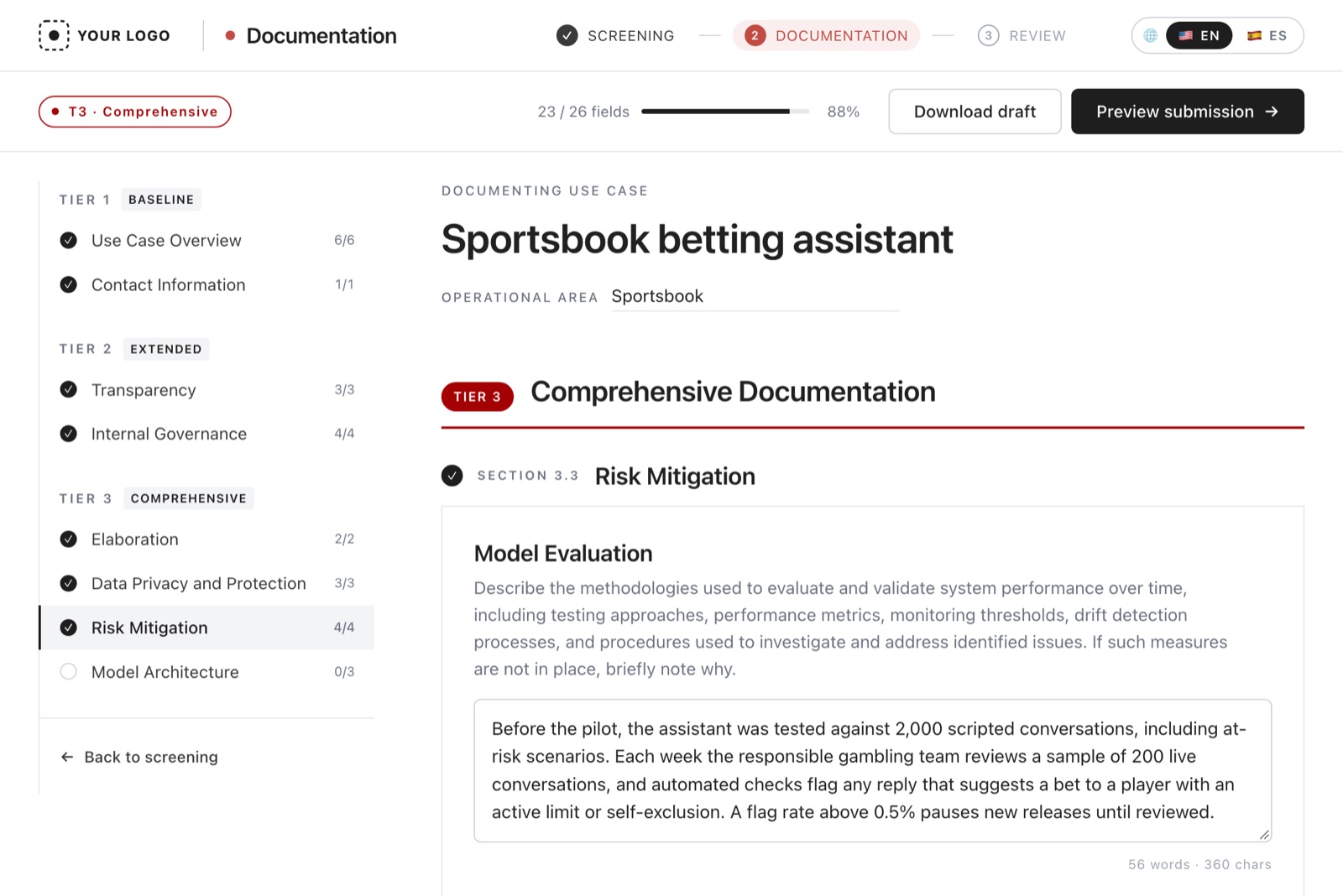
Complete only the fields that tier requires, then hand the record off to your organization's inventory.
Documentation tiers are set by a use case's potential impact on players
Tier 1
Baseline
Does not target, analyze, or address individual players. Operates on aggregates, documents, internal users, or non-player data.
Tier 2
Extended
Targets, analyzes, or communicates with individual players, but outputs are advisory, expressive, or experiential.
Tier 3
Comprehensive
Can materially affect a consequential outcome: access, money, protection, identity, or other consequential operations.
The framework
The research behind the registry
The registry is the product of an AiR Hub research project supported by funding from the ICE Research Institute, and refined through review with gambling sector stakeholders. These are its foundations as written in that project: what the registry is for, who it serves, how it is meant to be used, and the terms and tiers it rests on. More about the project.
What the registry is
At its core, the registry is designed to support a structured record of the AI use cases across an organization's gambling operations — capturing what each use case is and how it is governed, so that it can be reviewed and overseen.
The registry is intended to support responsible innovation by creating a "living" structured mechanism for various stakeholders and organizations to log and describe how AI systems are being used (i.e., "use cases"), what potential impacts they may have, and what governance measures are in place to support oversight, accountability, and player protection.
In practice, organizations can adopt this template as their own and host it on their own infrastructure, maintaining an internal inventory of the AI use cases across their gambling operations.
How it was designed, and who it's for
Existing transparency and reporting frameworks offer foundational principles, but they are not tailored to the nuances of the gambling industry. This registry was designed by drawing inspiration from those broader tools, but refined through direct engagement with gambling sector stakeholders to ensure it is fully contextualized for this unique landscape.
For Industry (Operators, Suppliers, etc.): It provides a structured internal framework to map, monitor, and manage AI deployments, ensuring alignment with corporate governance, risk management protocols, and evolving compliance standards.
For Regulators: It acts as a standardized tool that could be recommended or mandated, offering the visibility needed to supervise industry practices, uphold legislation, and protect consumers.
How to use the registry
- Adopt it at any scale: roll it out across an entire organization, run it within a single department or team, or use it individually to document your own AI use.
- Document each AI use case in one place — what it is, where it operates (department), who owns it (contact), and its deployment status — so your inventory stays auditable over time.
- Maintain it as a living record — revisit a use case and its screening whenever the underlying system is materially changed or repurposed.
- Give internal stakeholders visibility into your AI use — including who owns each system and who to contact about it — and share redacted records externally as a transparency mechanism for regulators, auditors, or the public.
Because the fields provided may not perfectly accommodate or be relevant to every single AI use case, we recommend making a best effort to complete all sections. If you are uncertain whether a specific field applies, we advise erring on the side of caution and conservative disclosure by filling it out.
Scope & limits
The registry is not currently intended to function as a mandatory regulatory requirement, certification system, or approval process. Instead, it is intended to support information-sharing, governance readiness, and cross-stakeholder understanding.
Key terms
- AI System
An AI system is a computational or machine-based system that, for explicit or implicit objectives, infers from the input it receives how to generate outputs such as predictions, content, recommendations, or decisions that can influence physical or virtual environments and players. This may include machine learning systems, generative AI, predictive analytics, behavioral models, recommendation systems, or advanced automated decision-support systems.
This definition is a recommended baseline, adapted from the OECD Recommendation on AI and the NIST AI Risk Management Framework. Adopting organizations may expand or adapt it to reflect their own context and risk appetite, but should avoid narrowing it below this scope.
- Use Case
A use case refers to a specific operational application of an AI system. A single AI system may support multiple use cases that fall into different impact tiers based on how the system is being used.
- Player Interaction & Impact
The extent to which an AI system's outputs affect individual players — whether applied automatically or acted on by a person. This ranges from interaction (targeting or communicating with players, or analyzing their behavior or data) to material impact (consequentially affecting their welfare, financial outcomes, access, behavior, fairness, autonomy, or regulatory treatment). Where a use case falls on this spectrum is what the screening assesses to assign its documentation tier.
- Documentation Tier
The documentation level assigned to a use case based on its potential impact on players. The tiers are additive — higher tiers require additional documentation on top of the tiers below.
The tiers in detail, with examples
Tier 1 Baseline
Tier 1 use cases do not target, analyze, or address individual players. They operate on aggregates, documents, internal users, or non-player data.
Examples: document summarization / translation tools; employee productivity copilots; spam filtering; aggregated operational analytics; internal scheduling systems.
Tier 2 Extended
Tier 2 use cases target, analyze, or communicate with individual players, but their outputs do not materially affect a consequential player outcome. Outputs are advisory in a non-directive sense, expressive, or experiential.
Examples: AI customer support assistant; AI-generated marketing copy; responsible gambling educational messaging; a chatbot that only answers basic FAQs; segmentation for general marketing.
Tier 3 Comprehensive
Tier 3 use cases can materially affect a consequential player outcome by automating, determining, recommending, or directively influencing decisions about:
- Access: account status, restrictions, exclusions, eligibility
- Money: deposits, withdrawals, limits, affordability, wagering decisions
- Protection: RG interventions, vulnerability classifications, harm-prevention measures
- Identity: biometric ID, KYC determinations
- Consequential operational decisions: differential treatment, dynamic pricing or odds, fraud determinations, or AML escalation
Examples: affordability assessments; RG risk scoring and intervention triggering; vulnerability classification; biometric ID / KYC systems; AML systems with automated escalation enforcement actions; a chatbot providing gambling recommendations, behavioral nudges, or RG directives; dynamic limits/odds based on behavioral profiling; open banking integrations affecting account decisions.
Make it yours
Everything is configurable
The registry ships as plain, readable source with content separated from presentation. Branding lives in one settings file and everything the registry asks in one content file per language, so most changes need no code at all.
Colors & theming
Every color is a CSS variable. Set your brand colors in registry.config.js and the whole tool follows.
Typography
Swap the heading and body typefaces in one place. Self-host your licensed fonts or point at any provider.
Screening questions
Add, remove, or reword questions and screening groups, and decide which tier each group assigns.
Form fields
Field names, prompts, input types, and section grouping all live in content/registry.en.js, keyed by stable IDs.
Logo & identity
Drop in your logo and organization name. The header, start page, and every exported record pick them up.
Languages
Ships in English and Spanish. Add a language by copying content/registry.es.js and translating it; the structure stays locked to the English source.
Tiers & thresholds
Three tiers by default. Redefine the tiers, their examples, and the materiality threshold to match your own risk appetite.
Start page
Set the heading and introduction, and add your own sections, such as how your organization uses the registry or who to ask.
Self-hosted
Static files with no backend and no telemetry. Host it behind your firewall, on an intranet, SharePoint, or any static host.
Your data, your systems
A front end that fits your workflow
The registry keeps nothing itself, and there is no database to run. When a use case is submitted, the record is handed off in standard formats, so it slots into whatever your organization already uses.
JSON record
The complete record with stable field IDs: the format to feed into internal systems, and to reopen later to update a use case.
Spreadsheet row
A CSV row with the same columns for every tier, so all your use cases append into one master inventory in Excel or Google Sheets.
Printable summary
A clean read-only summary to print or save as PDF, for review meetings or your own files.
Simplest setup
Keep one shared spreadsheet on SharePoint, OneDrive, or Google Drive, started from the included template. Add each submission's row, and keep the JSON and PDF in a shared folder.
Automated setup
Set submit.url and each record is also sent to an address you choose: the included Google Apps Script that appends to a Sheet, a Power Automate flow that adds a row to an Excel table, or your own API.
Records describe sensitive governance detail, so we recommend hosting the registry behind your company sign-in. The repository's deployment guide covers security, and the integrations guide walks through each setup.
Quick start
Running in a few minutes
No framework to learn and no database to provision. Clone it, edit two files, and publish anywhere that serves static files.
Clone the repository
Or download the latest release: a single HTML file that opens by double-click, nothing to install.
Configure your identity
Set your organization name, logo, colors, and fonts in
registry.config.js.Adapt the content
Review the screening questions and documentation fields in
content/registry.en.js. Adjust wording and tiers for your jurisdiction.Deploy
Publish to any static host your staff can reach: an internal server, SharePoint, or a cloud storage bucket. For production, use the compiled build attached to each release.
# 1 — get the source
git clone https://github.com/IGIAirhub/ai-use-case-registry
cd ai-use-case-registry

# 2 — make it yours
open registry.config.js       # brand, colors, fonts
open content/registry.en.js   # questions & fields

# 3 — preview locally
python3 -m http.server 8000   # or: npx serve .
License & governance
Free to adopt, adapt, and extend
The registry is released as a public good. Our aim is a shared reference model for AI transparency in the gambling sector, not a product, a certification scheme, or an approval process.
Apache 2.0 · CC BY 4.0
Use it however you need
Deploy it commercially, modify it privately, or fold parts of it into your existing governance tooling, with no obligation to publish your changes or your documented use cases. The software is Apache 2.0 and the framework content (questions, tiers, fields) is CC BY 4.0: when you share either, keep the credit to AiR Hub.
Stewardship
Maintained as research
Stewarded by AiR Hub at UNLV International Gaming Institute, and evolving through co-design with operators, suppliers, and regulators. Issues and pull requests are welcome.
Your data
Nothing is collected
No backend, no analytics, no phone-home. Records stay in the environment you deploy to, or go only where you choose to send them.
Not a mandate
Voluntary by design
A documentation and transparency mechanism, not a regulatory requirement. Organizations adopt it to build governance readiness; regulators may reference or recommend it as a standardized format.
See it before you fork it
Walk the full flow, from screening and tier assignment to tiered documentation, exactly as your teams would experience it.